
 English
 русский
 Español
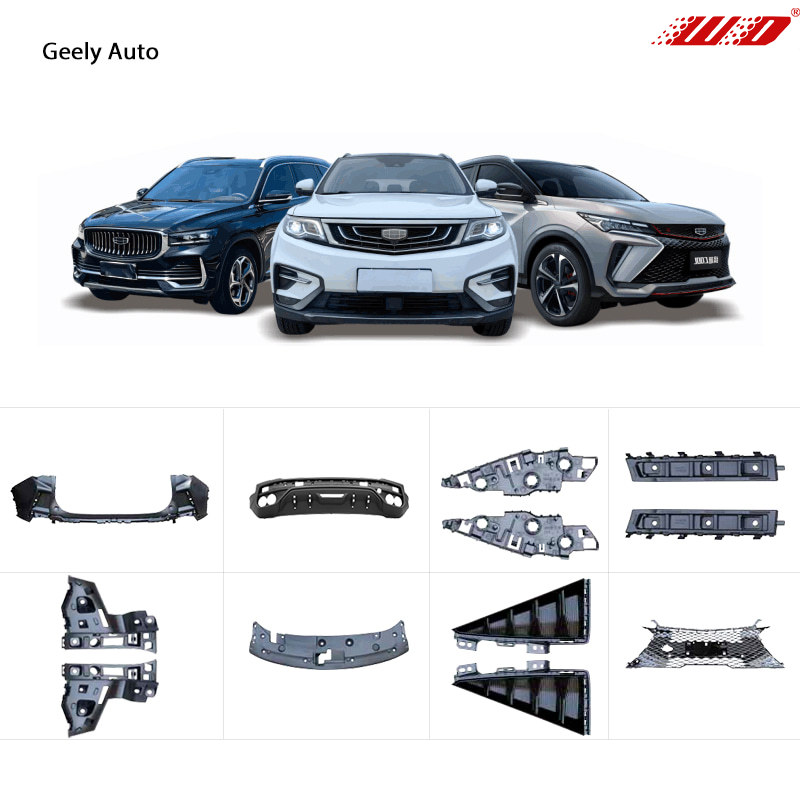
The back leverage component for the 2023 Geely SX11 rear bumper upper section serves as a structural interface that distributes impact force across the bumper assembly during low-speed collisions. Sourcing this part directly from the WD brand factory ensures dimensional homogeneity with the original vehicle specifications, eliminating the fitment gaps and stress concentrations that plague aftermarket alternatives. The component's primary value lies in its dual function: it acts as a rigid lever arm that transfers load to the energy-absorbing crash elements while simultaneously providing a cushioning buffer that protects the bumper cover from deformation under normal parking and maneuvering conditions.
Контент
- 1 Understanding the Back Leverage Function in Bumper Systems
- 2 Material Composition and Extrusion Resistance
- 3 Perfect Fit Through Factory-Direct Tooling
- 4 Cushioning Performance and Energy Absorption
- 5 Installation and Fitment Verification
- 6 Factory Direct Supply Chain Advantages
- 7 Distinguishing Genuine WD Components from Counterfeits
- 8 Long-Term Durability in Vehicle Service
Understanding the Back Leverage Function in Bumper Systems
Modern passenger vehicle bumper systems are not monolithic beams; they are layered assemblies that manage collision energy in stages. The back leverage component sits in the upper section of the rear bumper, bridging the gap between the outer bumper cover and the inner reinforcement beam. When a low-force impact occurs, such as a parking lot bump at 5 km/h or less, the leverage piece transfers the localized pressure from a single point of contact into a distributed load across the reinforcement structure. Without this component, the bumper cover flexes inward at the impact point and can crack the paint or tear the plastic mounting tabs. The Geely SX11 platform specifies this part with precise geometry that mates to the sheet metal stamping of the rear body panel, and any deviation in the lever's pivot point changes the force vector, potentially directing impact energy into the taillight housing or the rear quarter panel seam rather than into the designed crush path.
Load Distribution Mechanics
The lever principle at work is straightforward but critically dependent on exact dimensional matching. The back leverage piece contacts the bumper cover at a specific height and angle, set by the factory tooling. The contact surface area, typically 15 to 25 square centimeters, spreads the impact force so that pressure on the bumper cover remains below the yield threshold of the polypropylene material. If an aftermarket part has a contact face that is too small or misaligned by even 2mm, the pressure concentration can indent or puncture the cover. The WD brand maintains factory-original tooling data, so the contact geometry and leverage ratio are identical to the part originally installed on the Geely assembly line.
Material Composition and Extrusion Resistance
The back leverage component operates in an environment of cyclic compression and occasional impact. WD brand specifies a modified polypropylene composite or a glass-fiber-reinforced nylon, depending on the exact SX11 variant and model year. The critical mechanical property is compressive yield strength, which must exceed the peak force transmitted during a 5 km/h bumper impact without permanent deformation. For the Geely SX11 application, this value typically falls in the range of 40 to 55 MPa for the reinforced thermoplastic grade used. Extrusion resistance refers to the part's ability to maintain its cross-sectional shape under sustained clamping pressure from the mounting fasteners and under thermal cycling from -30°C winter ambient to +80°C summer solar soak on a dark-colored bumper. An inferior material creeps under the bolt torque, losing clamp load over time and developing rattles. The WD factory controls the glass fiber content to within ±2% by weight of the OEM specification, a tolerance that directly influences the part's creep modulus and long-term dimensional stability.
| Attribute | Requirement | WD Brand Compliance |
|---|---|---|
| Dimensional Tolerance | ±0.5mm on mounting points | Factory tooling matched |
| Compressive Strength | 40–55 MPa | Batch-tested composite |
| Thermal Range | -30°C to +80°C | Validated, no creep failure |
| Cushioning Response | Progressive deflection curve | OEM-identical rib design |
Perfect Fit Through Factory-Direct Tooling
The phrase "perfect fit" in collision repair parts is not marketing language; it is a geometric requirement with measurable consequences. The back leverage component mounts to the rear body panel using two to four locating pins or clips that index into stamped holes on the vehicle structure. These locating features establish the part's position in three axes before the fasteners are tightened. If the pin diameter is oversized or the center-to-center distance between pins deviates from the factory specification, the installer must force the part into position, which pre-stresses the plastic and creates a latent failure point. WD brand parts originate from tooling that is either the original production tooling or a licensed copy maintained to the identical cavity dimensions. This means the locating pins, mounting hole positions, and the contour where the part follows the body panel curvature are indistinguishable from the assembly-line part.
Homogeneity and Batch Consistency
Factory homogeneity means that part number WD-SX11-RBL-001 pulled from inventory in January and the same part number pulled in July are identical in material, dimensions, and performance. This consistency is achieved through controlled injection molding parameters: melt temperature held within ±5°C, mold temperature within ±3°C, injection pressure within ±5 bar, and cooling time held constant to the cycle. Each production batch undergoes a first-article inspection where critical dimensions are measured on a coordinate measuring machine and compared to the master CAD dataset. A dimensional report showing that all measured points fall within the ±0.5mm tolerance band accompanies the batch. For a body shop installing this part, homogeneity means the technician never needs to trim, shim, or drill a new hole to make the part fit.
Cushioning Performance and Energy Absorption
The cushioning function of the back leverage component is engineered into its rib structure. The part is not a solid block; it contains a network of thin, vertical ribs that buckle progressively under compression. This ribcage design absorbs energy through controlled plastic deformation, converting kinetic energy into heat within the polymer matrix. The rib thickness, spacing, and height are tuned to the specific bumper profile of the Geely SX11. A rib thickness of 1.5mm to 2.2mm is typical, with rib spacing of 8mm to 12mm. If the ribs are too thick, the part is too stiff and transmits too much force to the body structure before the ribs buckle. If too thin, the ribs collapse at a force too low to contribute meaningfully to energy management. The WD part replicates the OEM rib geometry, so the force-deflection curve matches the vehicle's original crash pulse calibration for low-speed bumper impacts under RCAR test protocols.
Installation and Fitment Verification
Installing the back leverage component is typically part of a rear bumper replacement or repair procedure following a collision. The sequence requires removing the rear bumper cover, which involves releasing clips along the bottom edge, inside the wheel arches, and along the taillight seams. Once the cover is removed, the back leverage piece is visible attached to the upper portion of the rear body panel or the reinforcement beam. Removal involves releasing plastic push-pins or 10mm bolts. The new WD part slides into position, and the locating pins should drop into the body holes without resistance. If resistance is encountered, the part is either misoriented or the vehicle structure underneath is still deformed from the collision and requires additional straightening. The fasteners are tightened to the Geely specified torque, which for a typical M6 plastic-to-metal joint is in the range of 4 to 6 Nm. Over-torquing crushes the plastic mounting boss; under-torquing invites vibration loosening. After installation, the bumper cover is rehung and the gap to the adjacent panels is checked. The gap between the bumper cover and the rear quarter panel should be uniform at 3mm to 4mm along its length. An uneven gap suggests the back leverage piece is not seated correctly or the bumper cover itself is distorted.
Factory Direct Supply Chain Advantages
Purchasing the back leverage component directly from the WD brand factory shortens the supply chain to a single link, eliminating the markup layers of regional distributors, wholesalers, and retailer stocking fees. This direct channel also accelerates the response to technical inquiries. If a body shop encounters a fitment question specific to a Geely SX11 manufactured in a particular production month, the WD factory engineering team can trace the part revision history and confirm compatibility within hours rather than days. The direct sales model further ensures that the part is not a repackaged universal component relabeled for multiple vehicle models. The packaging carries the WD brand hologram and a QR code that links to the production batch record, material certification, and dimensional inspection report. This traceability supports insurance repair documentation requirements, where the parts invoice must demonstrate that replacement components meet OEM specifications for the repair to be warrantied.
Distinguishing Genuine WD Components from Counterfeits
The aftermarket for Geely collision parts includes counterfeit products that mimic the WD brand packaging and labeling. These counterfeit leverage components typically use recycled or off-spec polypropylene with lower fiber content or degraded impact modifiers. The visual tell is often the surface finish: a genuine WD part has a uniform matte texture from the mold cavity, while a counterfeit part may show flow lines, sink marks, or a glossy surface indicating a different polymer grade or improper mold temperature. The weight of the part is also a reliable indicator. A genuine WD back leverage piece for the SX11 weighs within ±5 grams of the specified mass; a counterfeit may be lighter due to reduced glass fiber content or thinner wall sections. The QR code on the packaging is the definitive authentication method, linking to a WD-hosted verification page that confirms the serial number's validity and the date of manufacture.
Long-Term Durability in Vehicle Service
Once installed, the back leverage component endures a service environment that includes road vibration, exhaust heat on the passenger side, moisture exposure from rain and car washes, and occasional minor bumper contact. The WD material formulation includes UV stabilizers and thermal antioxidants that prevent the embrittlement that causes aftermarket parts to crack after two to three years of sun exposure. Accelerated weathering tests per SAE J2527, exposing the part to 2,000 hours of xenon arc radiation with moisture cycles, confirm that the material retains at least 80% of its original tensile strength and impact resistance after a simulated service life equivalent to ten years in a temperate climate. This durability translates to a component that continues to support the bumper cover, maintain panel gaps, and cushion impacts for the remaining service life of the vehicle, not just the immediate post-repair period.